Sunday, October 18, 2015
Lab 6 Blood
It
is easy to determine an individual's ABO type from a few drops of blood. A
serum containing antibody A (anti-A) is mixed with some of the blood.
Another serum with antibody B (anti-B) is mixed with another sample. Whether or
not agglutination occurs in either sample indicates the blood type. For
instance, if an individual's blood sample is agglutinated by antibody A, but
not antibody B, it means that the A antigen is present but not the B antigen.
Therefore, the blood type is A.

Thursday, October 8, 2015
Lab 7 Immune System
Blood, Erythrocytes & Leukocytes
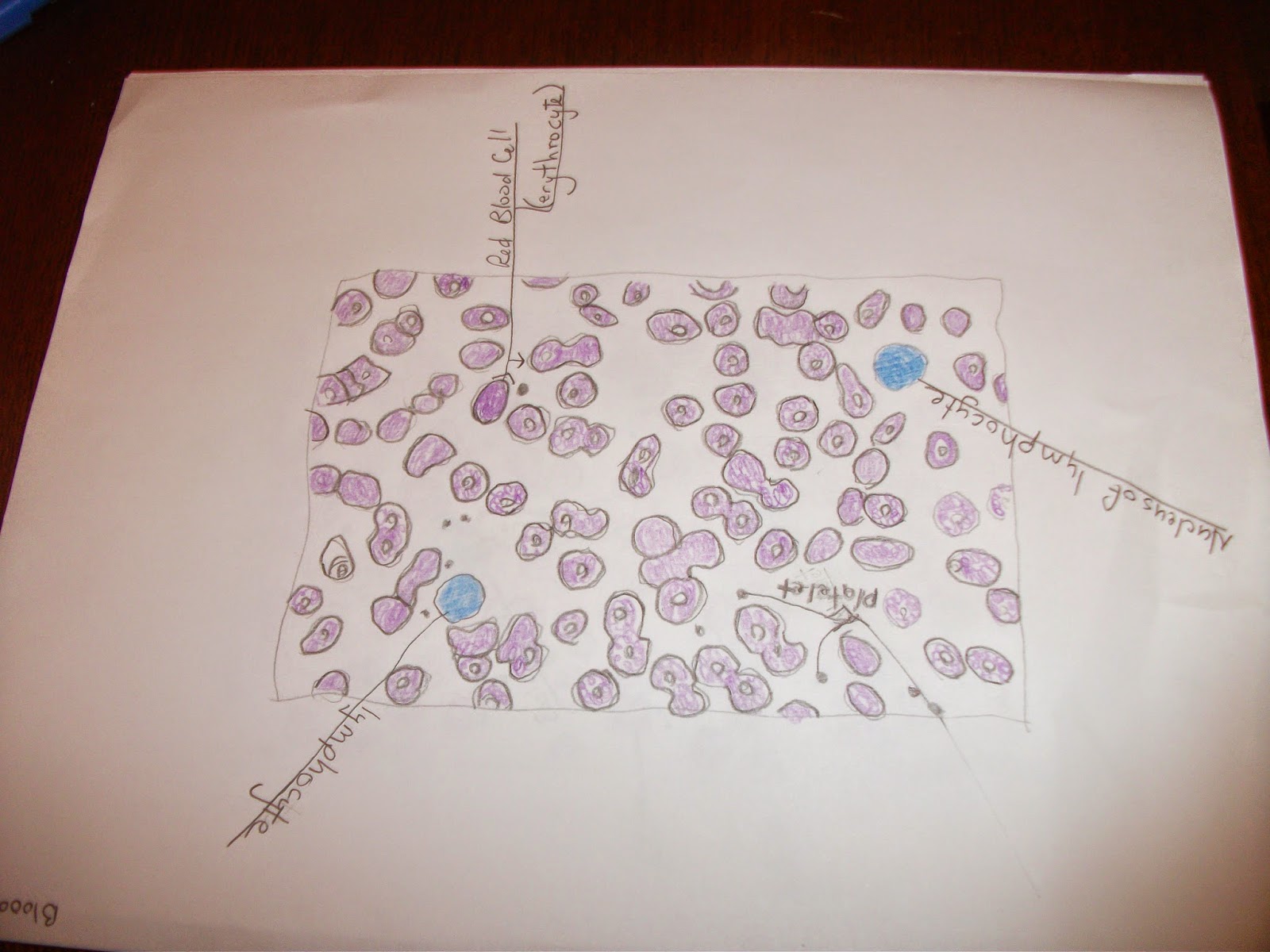
Erythrocytes

Basophil

Neutro
Lymphatic System

Tonsil
The lymphatic system is physiologically and anatomically related to the cardiovascular system by the way that the cardiovascular system takes blood and the nutrients
that the blood caries (oxygen, "food", etc.) around to the body,
while the lymphatic system basically picks up and recirculates the fluids that
the circulatory system dropped along the way. The lymphatic system makes the
circulatory system not have to work as hard (otherwise, the circulatory system
would have to deposit nutrients AND pick up fluids)
Nonspecific Body Defenses
The three ways the integumentary system provieds the first line of defense are:a. Skin: Acts as a barrier that protects us from injury, infection, and dehydration
b. Tears, Saliva &
Earwax: Tears lubricate the eyes and washing away particles. Tears and Saliva
both contain lysozyme, an enzyme that kills many bacteria. Earwax traps small particles
and microorganisms.
c. Mucus: A thick,
gel-like material secreted by cells at various surfaces of the body, including
the lining of the digestive tract and branching airways of the respiratory system. Microorganisms that come into contract with
the sticky mucus become trapped and cannot gain access to the cells beneath.
The primary tissue type that cilia arise from is the Epithelium
The process of phagocytosis
1) Phagocyte approaches
and captures bacterium
2) Phagocyte surrounds
bacterium
3) Bacterium becomes
enclosed in vesicle
4) Vesicle fuses with
lysosomes
5) Lysosomal enzymes
digest bacterium
6) Wastes and debris are
discarded

The Process of Phagocytosis
The two types of Phagocytosis are shown below:
Neutrophil

Eosinophil
The process involved in the inflammatory response is when
tissues are injured the damaged cells release chemicals as an alarm for the
process to begin. These chemicals stimulate mast cells, which are connective
tissue cells specialized to release histamine. Histamine dilates blood vessels
and makes them leaky. Complement proteins from plasma diffuse and sometimes
kill them. Attracted by histamine chemicals, phagocytes and other squeeze
through the leaky capillary walls and begin attacking and engulfing bacteria
and debris.
Mechanism by which complement kills bacteria

a. Activated complement proteins from complexes of proteins that create
holes in the bacterial wall.
b. Water and salts diffuse into the bacterium through the holes
c.
The
bacterium swells and eventually burst.
Specific Body Defenses
The major histocompatibility complex is when a group of genes that code for proteins found on the survaces of cells help the immune system recognize foreign substances.

Basic structure of an antibody
There are 5 different types of antibodies that a person has in their body. They are as follows:
a.
IgG
–Activate the complement system and neutralize many toxins. They are the only antibodies that cross the
placenta during pregnancy and pass on the mother’s acquired immunities to the
fetus.
b.
IgM
–Are the first to be released during immune responses. They activate the complement system and cause
foreign cells to agglutinate.
c.
IgA
–Enter areas of the body covered by mucous membranes. They neutralize infectious pathogens.
d.
IgD
–This antibody is in the B Cell, blood & lymph. Not sure they may play a role in the B Cell.
e.
IgE
–In the B Cell, mast cells and basophils.
They activate the inflammatory response by triggering the release of
histamine.

Colonal Expansion
The colonal expansion is production of daughter
cells all arising
originally from a single cell.
The interfeon operats by stimulating the production of proteins that interfere with viral reproduction.
There are two differences between cell mediated and antibody mediated immune response and they are:
- B cells produce circulating antibodies
- T cells either release chemicals that simulate other cells of the immune system or they directly attack the foreign cell and kill it. Secondly, the T cells receptors cannot recognize whole anitgens - they only react to small fragments or antigens.
The cells involved in the cell mediated immune reponse are the following:
- C Lymphocytes
- B Lymphocytes
- Macrophages
The cells involved in the antibody mediate immun reponse are as follows:
- B Lymphocytes
- Plsama Cells
The difference between passive immunization and active immunization are:
a.
Passive Immunization – Helps against existing or
anticipated infections. This is done by
receiving a gamma globulin shot. However
protection is not as long-lasting as Active Immunization. Passive Immunization cannot confer long-term
immunity against a second exposure.
Example of Passive Immunization are Measles, Hepatitis B & Tetanus.
b.
Active Immunization - The process of activating
the body’s immune system in advance.
Getting a vaccine of antigen produced from dead or weakened
pathogens. An example is the oral Polio
vaccine.
Johnson, Michael. "Human Biology." Human Biology. 1 Sept. 2014. Web. 16 Oct. 2015.
Subscribe to:
Posts (Atom)